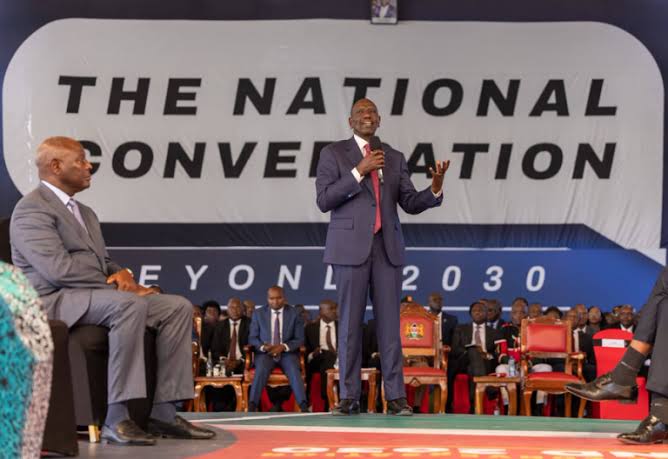
President William Ruto’s address on Wednesday, August 12, 2026, placed Kenya’s long-term development ambitions firmly at the centre of national debate, as the country began the process of shaping a development framework intended to succeed Vision 2030.
Speaking during the national conversation on Kenya’s future beyond 2030 at the Kenyatta International Convention Centre, Ruto argued that Kenya must begin planning beyond the country’s electoral cycles and focus on the needs of generations that will come after today’s political leadership.
The proposed Vision 2060 is therefore being presented not simply as another government programme, but as an attempt to define what kind of country Kenya wants to become over the next several decades.
Why 2060?
Kenya’s Vision 2030 has been the country’s principal long-term development blueprint since its launch in 2008. With its target year approaching, the government argues that Kenya needs a successor framework capable of addressing a substantially different economic, technological and environmental landscape.
Ruto has pointed to rapid technological change, artificial intelligence, climate change and transformations in the global economy as reasons for reconsidering Kenya’s long-term development trajectory.
The President has also used comparisons with countries such as South Korea, China and Vietnam to illustrate what he regards as Kenya’s missed development opportunities. In his earlier national address launching the process, he noted that Kenya and South Korea had comparable GDP-per-capita levels in the 1960s, while their economic trajectories have since diverged significantly.
The argument is straightforward: Kenya cannot assume that the strategies appropriate for the next few years will necessarily be adequate for the next three decades.
A plan beyond one administration
One of the central arguments advanced by the President is that Kenya has historically been too focused on the next election rather than the next generation.
At the KICC, Ruto argued that political considerations should not prevent the country from making decisions whose benefits may only become visible decades later. He called on Kenyans to contribute ideas rather than leaving the process exclusively to government.
This is an important principle in any long-term development strategy.
A national development blueprint that survives changes in government can provide continuity in infrastructure, education, healthcare, environmental management, industrialization and economic policy. But achieving that continuity requires something more than presidential endorsement.
It requires broad political ownership and public participation.
The question of public participation
The government has repeatedly emphasized that Vision 2060 should be citizen-driven.
Ruto has acknowledged that some of the shortcomings associated with Vision 2030 were linked to inadequate public participation and has argued that the next framework should be developed differently.
That creates an important test for the process now underway.
Kenya has a constitutional commitment to public participation. The question is therefore not simply whether Kenyans will be invited to meetings, but whether their ideas will materially influence the final document.
A genuine national conversation would need to accommodate different perspectives from government and opposition politicians to county governments, businesses, civil society, academia, young people, farmers, informal-sector workers and communities whose development priorities may differ considerably.
The government's own earlier announcement described the process as inclusive, transparent, people-driven and national in character.
Whether that ambition is achieved will ultimately be judged by the final framework and how Kenyans participate in shaping it.
The political question cannot be ignored
The timing of the conversation has already generated political debate.
Some critics argue that launching a major national development conversation so close to the 2027 General Election risks turning Vision 2060 into a political instrument. Others have questioned whether the country should be discussing 2060 while still struggling with problems that require immediate attention.
An economist, Odhiambo Ramogi, has even argued that the Vision 2060 discussions should be postponed until after the 2027 election.
Those concerns cannot simply be dismissed.
At the same time, delaying every long-term national discussion because an election is approaching could create its own problem. Kenya will continue to require planning regardless of who wins the next election.
The more useful question may therefore be whether the process can be insulated from partisan politics and designed so that successive administrations are able and expected to implement it.
Vision 2060 must also answer today's questions
There is another challenge.
It is difficult to persuade citizens to think about 2060 when many are primarily concerned about the cost of living, employment, healthcare, education, housing, food security, water and sanitation.
Long-term planning and immediate problems should not be treated as competing priorities.
In fact, a credible Vision 2060 should demonstrate how solving today's problems contributes to the Kenya of 2060.
For example, investments in water security today will determine whether future cities and agricultural regions can withstand population growth and climate pressure. Investments in sanitation and wastewater treatment will affect public health and the quality of Kenya's rivers and lakes decades from now. Investments in renewable energy, sustainable agriculture, forests and climate-resilient infrastructure will influence the country's environmental security.
The same applies to education, digital infrastructure, healthcare and employment.
The Kenya of 2060 will ultimately be built through decisions made in 2026, 2027, 2030 and every year thereafter.
## From vision to implementation
Perhaps the biggest challenge facing Vision 2060 is not the ambition of the idea but implementation.
Kenya has never suffered from a shortage of development plans.
The more difficult question has consistently been how effectively national plans translate into funded programmes, completed projects, functioning institutions and measurable improvements in people's lives.
A successful Vision 2060 would therefore need clear priorities, measurable targets, realistic financing mechanisms and institutional arrangements capable of surviving political transitions.
It would also need mechanisms for monitoring progress and holding institutions accountable.
Without these safeguards, Vision 2060 could become another impressive document that generates headlines at its launch but gradually loses relevance as governments change.
A conversation worth having
President Ruto's call to think beyond elections raises an important national question regardless of one's political position.
What should Kenya look like in 2060?
Should it be a highly industrialized economy? A regional technology and innovation hub? A food-secure country? A leader in renewable energy? A country with universal access to safe water and sanitation? A manufacturing centre for Africa? A climate-resilient economy? Or all of these?
The answer cannot belong to one president, one political party or one administration.
That is perhaps the most important test facing the Vision 2060 process.
If it becomes primarily a government project, it may struggle to survive political transitions. If it becomes a genuinely national project, it has a greater chance of becoming a shared development compass for successive administrations.
Ruto has opened the conversation. The responsibility now extends beyond State House.
Kenyans will have to decide what future they want and, more importantly, what they are prepared to do today to make that future possible.
Vision 2060 is therefore not only about where Kenya wants to be in 34 years.
It is ultimately about the choices Kenya makes now.
Speaking during the national conversation on Kenya’s future beyond 2030 at the Kenyatta International Convention Centre, Ruto argued that Kenya must begin planning beyond the country’s electoral cycles and focus on the needs of generations that will come after today’s political leadership.
The proposed Vision 2060 is therefore being presented not simply as another government programme, but as an attempt to define what kind of country Kenya wants to become over the next several decades.
Why 2060?
Kenya’s Vision 2030 has been the country’s principal long-term development blueprint since its launch in 2008. With its target year approaching, the government argues that Kenya needs a successor framework capable of addressing a substantially different economic, technological and environmental landscape.
Ruto has pointed to rapid technological change, artificial intelligence, climate change and transformations in the global economy as reasons for reconsidering Kenya’s long-term development trajectory.
The President has also used comparisons with countries such as South Korea, China and Vietnam to illustrate what he regards as Kenya’s missed development opportunities. In his earlier national address launching the process, he noted that Kenya and South Korea had comparable GDP-per-capita levels in the 1960s, while their economic trajectories have since diverged significantly.
The argument is straightforward: Kenya cannot assume that the strategies appropriate for the next few years will necessarily be adequate for the next three decades.
A plan beyond one administration
One of the central arguments advanced by the President is that Kenya has historically been too focused on the next election rather than the next generation.
At the KICC, Ruto argued that political considerations should not prevent the country from making decisions whose benefits may only become visible decades later. He called on Kenyans to contribute ideas rather than leaving the process exclusively to government.
This is an important principle in any long-term development strategy.
A national development blueprint that survives changes in government can provide continuity in infrastructure, education, healthcare, environmental management, industrialization and economic policy. But achieving that continuity requires something more than presidential endorsement.
It requires broad political ownership and public participation.
The question of public participation
The government has repeatedly emphasized that Vision 2060 should be citizen-driven.
Ruto has acknowledged that some of the shortcomings associated with Vision 2030 were linked to inadequate public participation and has argued that the next framework should be developed differently.
That creates an important test for the process now underway.
Kenya has a constitutional commitment to public participation. The question is therefore not simply whether Kenyans will be invited to meetings, but whether their ideas will materially influence the final document.
A genuine national conversation would need to accommodate different perspectives from government and opposition politicians to county governments, businesses, civil society, academia, young people, farmers, informal-sector workers and communities whose development priorities may differ considerably.
The government's own earlier announcement described the process as inclusive, transparent, people-driven and national in character.
Whether that ambition is achieved will ultimately be judged by the final framework and how Kenyans participate in shaping it.
The political question cannot be ignored
The timing of the conversation has already generated political debate.
Some critics argue that launching a major national development conversation so close to the 2027 General Election risks turning Vision 2060 into a political instrument. Others have questioned whether the country should be discussing 2060 while still struggling with problems that require immediate attention.
An economist, Odhiambo Ramogi, has even argued that the Vision 2060 discussions should be postponed until after the 2027 election.
Those concerns cannot simply be dismissed.
At the same time, delaying every long-term national discussion because an election is approaching could create its own problem. Kenya will continue to require planning regardless of who wins the next election.
The more useful question may therefore be whether the process can be insulated from partisan politics and designed so that successive administrations are able and expected to implement it.
Vision 2060 must also answer today's questions
There is another challenge.
It is difficult to persuade citizens to think about 2060 when many are primarily concerned about the cost of living, employment, healthcare, education, housing, food security, water and sanitation.
Long-term planning and immediate problems should not be treated as competing priorities.
In fact, a credible Vision 2060 should demonstrate how solving today's problems contributes to the Kenya of 2060.
For example, investments in water security today will determine whether future cities and agricultural regions can withstand population growth and climate pressure. Investments in sanitation and wastewater treatment will affect public health and the quality of Kenya's rivers and lakes decades from now. Investments in renewable energy, sustainable agriculture, forests and climate-resilient infrastructure will influence the country's environmental security.
The same applies to education, digital infrastructure, healthcare and employment.
The Kenya of 2060 will ultimately be built through decisions made in 2026, 2027, 2030 and every year thereafter.
## From vision to implementation
Perhaps the biggest challenge facing Vision 2060 is not the ambition of the idea but implementation.
Kenya has never suffered from a shortage of development plans.
The more difficult question has consistently been how effectively national plans translate into funded programmes, completed projects, functioning institutions and measurable improvements in people's lives.
A successful Vision 2060 would therefore need clear priorities, measurable targets, realistic financing mechanisms and institutional arrangements capable of surviving political transitions.
It would also need mechanisms for monitoring progress and holding institutions accountable.
Without these safeguards, Vision 2060 could become another impressive document that generates headlines at its launch but gradually loses relevance as governments change.
A conversation worth having
President Ruto's call to think beyond elections raises an important national question regardless of one's political position.
What should Kenya look like in 2060?
Should it be a highly industrialized economy? A regional technology and innovation hub? A food-secure country? A leader in renewable energy? A country with universal access to safe water and sanitation? A manufacturing centre for Africa? A climate-resilient economy? Or all of these?
The answer cannot belong to one president, one political party or one administration.
That is perhaps the most important test facing the Vision 2060 process.
If it becomes primarily a government project, it may struggle to survive political transitions. If it becomes a genuinely national project, it has a greater chance of becoming a shared development compass for successive administrations.
Ruto has opened the conversation. The responsibility now extends beyond State House.
Kenyans will have to decide what future they want and, more importantly, what they are prepared to do today to make that future possible.
Vision 2060 is therefore not only about where Kenya wants to be in 34 years.
It is ultimately about the choices Kenya makes now.