






For decades, Kenyan politics has operated on a familiar map.
Some regions were considered “owned” by particular parties. Mount Kenya was associated with one political camp, Nyanza with another, parts of Western had their traditional political homes, while Ukambani, the Coast and the Rift Valley also had recognisable political loyalties.
But as Kenya moves toward the 2027 General Election, that old political map is becoming harder to read.
The question is no longer simply which party controls which region?
It is increasingly becoming: how long can a political party rely on a traditional stronghold?
Recent developments suggest that the answer may be: not forever.
The numbers are already showing movement
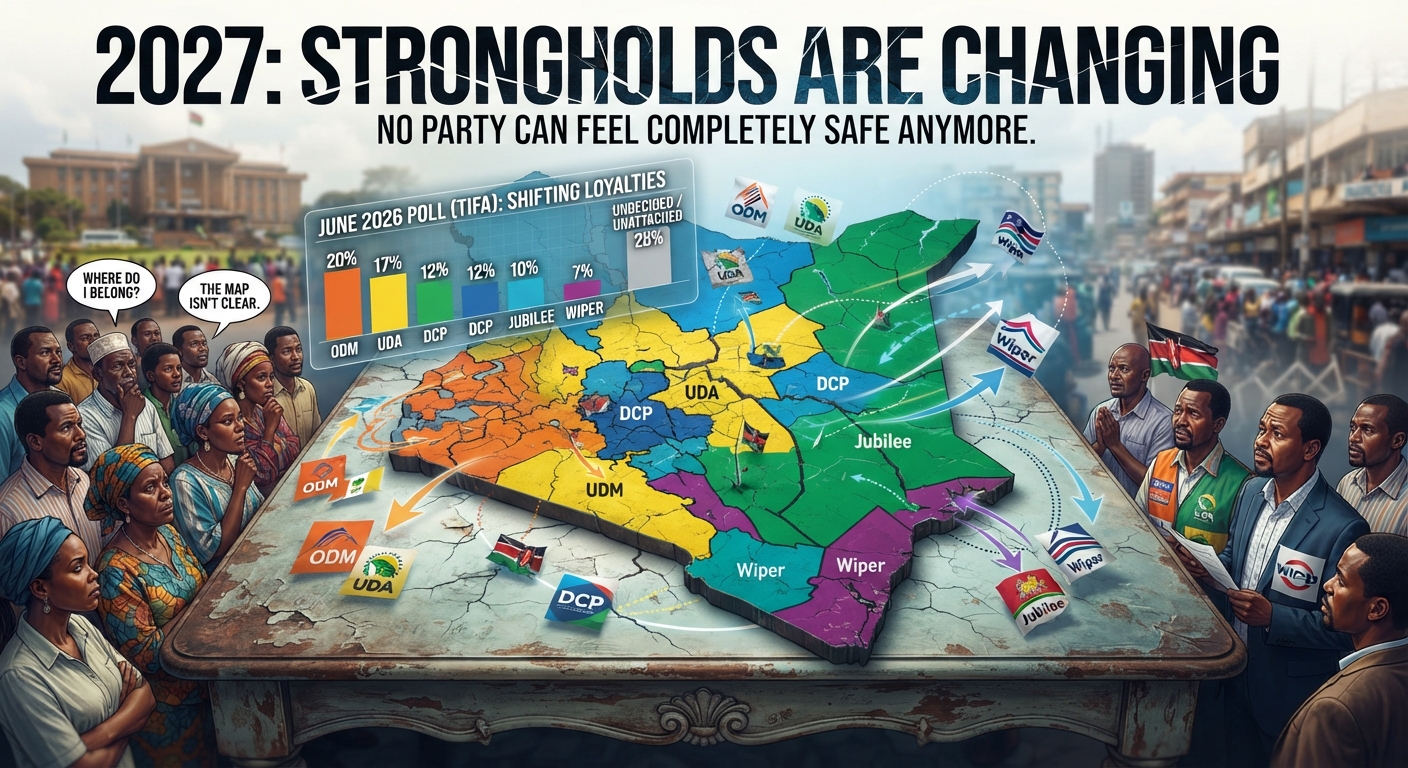
A June 2026 TIFA survey illustrates how fluid the political environment has become. ODM had 20% party support nationally, followed by UDA at 17%, DCP at 12%, Jubilee at 10% and Wiper at 7%. Most notably, 28% of respondents said they did not identify with any political party.
That undecided or unattached segment matters because it means a significant portion of the electorate cannot simply be assigned to the traditional political camps.
Another Infotrak survey reported in July showed UDA and ODM losing some of the dominance they previously enjoyed in their traditional bases. In Mount Kenya, for example, UDA was reported at 9%, while DCP was at 33%, with 36% undecided.
These figures should not be treated as predictions of what will happen in 2027. They are snapshots of voter sentiment at particular moments. But they do demonstrate something important:
Political loyalty is moving.
Mount Kenya is no longer a simple equation
Mount Kenya has historically been one of the most important pieces of Kenya's presidential electoral mathematics.
But the region is now experiencing competition between different political formations, including UDA, DCP and Jubilee.
The emergence of DCP under former Deputy President Rigathi Gachagua has complicated the assumption that the region will automatically follow the political direction of the national government. At the same time, a sizeable share of voters in the Infotrak findings remained undecided.
This does not mean one party has permanently taken over.
It means the old certainty is disappearing.
Nyanza is also experiencing a political reset
For years, Nyanza was among the clearest examples of a regional political stronghold.
ODM's influence in counties such as Kisumu, Siaya, Homa Bay and Migori has been central to Kenya's electoral calculations.
But the political environment has changed.
UDA is attempting to expand into areas historically associated with ODM, while internal competition within ODM and the emergence of new political alliances are creating additional uncertainty. Recent reporting has described both Nyanza and Mount Kenya as regions undergoing a political reset.
The debate over zoning makes this even more obvious.
ODM has pushed for arrangements that would protect areas it considers its traditional strongholds, while UDA has argued that parties should be allowed to compete across the country.
Why fight so hard over zoning?
Because political parties increasingly understand that there may no longer be such a thing as an untouchable stronghold.
The Coast and Western Kenya are also part of the contest
The same pattern is visible beyond Mount Kenya and Nyanza.
Political parties are seeking to expand their presence into regions historically dominated by competitors. Meanwhile, smaller parties are positioning themselves as alternative political homes for politicians who may not secure nominations in the major parties.
That is why parties such as PAA, MDG, UDM, DAP-K and others have become part of the wider 2027 conversation.
The result is a more complicated political marketplace.
A politician may belong to one coalition nationally, contest under another party locally and still support a broader alliance at the presidential level.
For voters, this can make the ballot increasingly difficult to interpret.
The smaller parties may become more important
Kenyan politics has traditionally revolved around major parties and presidential coalitions.
But 2027 could produce a more fragmented political landscape.
When major parties negotiate zoning and nominations, some politicians inevitably find themselves without tickets. Smaller parties can then become alternative vehicles for those candidates.
This could make some constituencies and counties much more competitive.
It also means that party colours may not tell the whole story.
A candidate's personal following, local alliances, development record, family networks and relationship with voters may matter as much as or sometimes more than the national party label.
The biggest change may actually be the voter
Perhaps the most interesting part of the 2027 equation is not what politicians are doing.
It is what voters are doing.
The TIFA finding that 28% of respondents did not identify with a political party suggests that many Kenyans are not permanently tied to party identities.
That creates room for political movements to enter territories that once appeared closed.
It also means that politicians cannot necessarily assume that yesterday's voting pattern will automatically be repeated tomorrow.
Kenya's political history has repeatedly shown that alliances can change dramatically before an election. The current realignments are another reminder that political coalitions are often fluid rather than permanent.
So, what does 2027 look like?
It looks less predictable.
UDA cannot simply assume every region associated with its 2022 coalition will remain unchanged.
ODM cannot automatically assume its traditional bases will remain politically uniform.
DCP cannot assume that increased support in particular regions will automatically translate into electoral control.
And smaller parties cannot be dismissed simply because they lack the national visibility of the major formations.
The 2027 election is gradually becoming a contest not just between parties, but between old loyalties and new political identities.
The strongest political asset may no longer be a traditional stronghold.
It may be the ability to persuade voters who are no longer certain where they belong.
And that is what makes 2027 different.
The political map is being redrawn and this time, nobody can confidently colour the whole map in advance.
Some regions were considered “owned” by particular parties. Mount Kenya was associated with one political camp, Nyanza with another, parts of Western had their traditional political homes, while Ukambani, the Coast and the Rift Valley also had recognisable political loyalties.
But as Kenya moves toward the 2027 General Election, that old political map is becoming harder to read.
The question is no longer simply which party controls which region?
It is increasingly becoming: how long can a political party rely on a traditional stronghold?
Recent developments suggest that the answer may be: not forever.
The numbers are already showing movement
A June 2026 TIFA survey illustrates how fluid the political environment has become. ODM had 20% party support nationally, followed by UDA at 17%, DCP at 12%, Jubilee at 10% and Wiper at 7%. Most notably, 28% of respondents said they did not identify with any political party.
That undecided or unattached segment matters because it means a significant portion of the electorate cannot simply be assigned to the traditional political camps.
Another Infotrak survey reported in July showed UDA and ODM losing some of the dominance they previously enjoyed in their traditional bases. In Mount Kenya, for example, UDA was reported at 9%, while DCP was at 33%, with 36% undecided.
These figures should not be treated as predictions of what will happen in 2027. They are snapshots of voter sentiment at particular moments. But they do demonstrate something important:
Political loyalty is moving.
Mount Kenya is no longer a simple equation
Mount Kenya has historically been one of the most important pieces of Kenya's presidential electoral mathematics.
But the region is now experiencing competition between different political formations, including UDA, DCP and Jubilee.
The emergence of DCP under former Deputy President Rigathi Gachagua has complicated the assumption that the region will automatically follow the political direction of the national government. At the same time, a sizeable share of voters in the Infotrak findings remained undecided.
This does not mean one party has permanently taken over.
It means the old certainty is disappearing.
Nyanza is also experiencing a political reset
For years, Nyanza was among the clearest examples of a regional political stronghold.
ODM's influence in counties such as Kisumu, Siaya, Homa Bay and Migori has been central to Kenya's electoral calculations.
But the political environment has changed.
UDA is attempting to expand into areas historically associated with ODM, while internal competition within ODM and the emergence of new political alliances are creating additional uncertainty. Recent reporting has described both Nyanza and Mount Kenya as regions undergoing a political reset.
The debate over zoning makes this even more obvious.
ODM has pushed for arrangements that would protect areas it considers its traditional strongholds, while UDA has argued that parties should be allowed to compete across the country.
Why fight so hard over zoning?
Because political parties increasingly understand that there may no longer be such a thing as an untouchable stronghold.
The Coast and Western Kenya are also part of the contest
The same pattern is visible beyond Mount Kenya and Nyanza.
Political parties are seeking to expand their presence into regions historically dominated by competitors. Meanwhile, smaller parties are positioning themselves as alternative political homes for politicians who may not secure nominations in the major parties.
That is why parties such as PAA, MDG, UDM, DAP-K and others have become part of the wider 2027 conversation.
The result is a more complicated political marketplace.
A politician may belong to one coalition nationally, contest under another party locally and still support a broader alliance at the presidential level.
For voters, this can make the ballot increasingly difficult to interpret.
The smaller parties may become more important
Kenyan politics has traditionally revolved around major parties and presidential coalitions.
But 2027 could produce a more fragmented political landscape.
When major parties negotiate zoning and nominations, some politicians inevitably find themselves without tickets. Smaller parties can then become alternative vehicles for those candidates.
This could make some constituencies and counties much more competitive.
It also means that party colours may not tell the whole story.
A candidate's personal following, local alliances, development record, family networks and relationship with voters may matter as much as or sometimes more than the national party label.
The biggest change may actually be the voter
Perhaps the most interesting part of the 2027 equation is not what politicians are doing.
It is what voters are doing.
The TIFA finding that 28% of respondents did not identify with a political party suggests that many Kenyans are not permanently tied to party identities.
That creates room for political movements to enter territories that once appeared closed.
It also means that politicians cannot necessarily assume that yesterday's voting pattern will automatically be repeated tomorrow.
Kenya's political history has repeatedly shown that alliances can change dramatically before an election. The current realignments are another reminder that political coalitions are often fluid rather than permanent.
So, what does 2027 look like?
It looks less predictable.
UDA cannot simply assume every region associated with its 2022 coalition will remain unchanged.
ODM cannot automatically assume its traditional bases will remain politically uniform.
DCP cannot assume that increased support in particular regions will automatically translate into electoral control.
And smaller parties cannot be dismissed simply because they lack the national visibility of the major formations.
The 2027 election is gradually becoming a contest not just between parties, but between old loyalties and new political identities.
The strongest political asset may no longer be a traditional stronghold.
It may be the ability to persuade voters who are no longer certain where they belong.
And that is what makes 2027 different.
The political map is being redrawn and this time, nobody can confidently colour the whole map in advance.